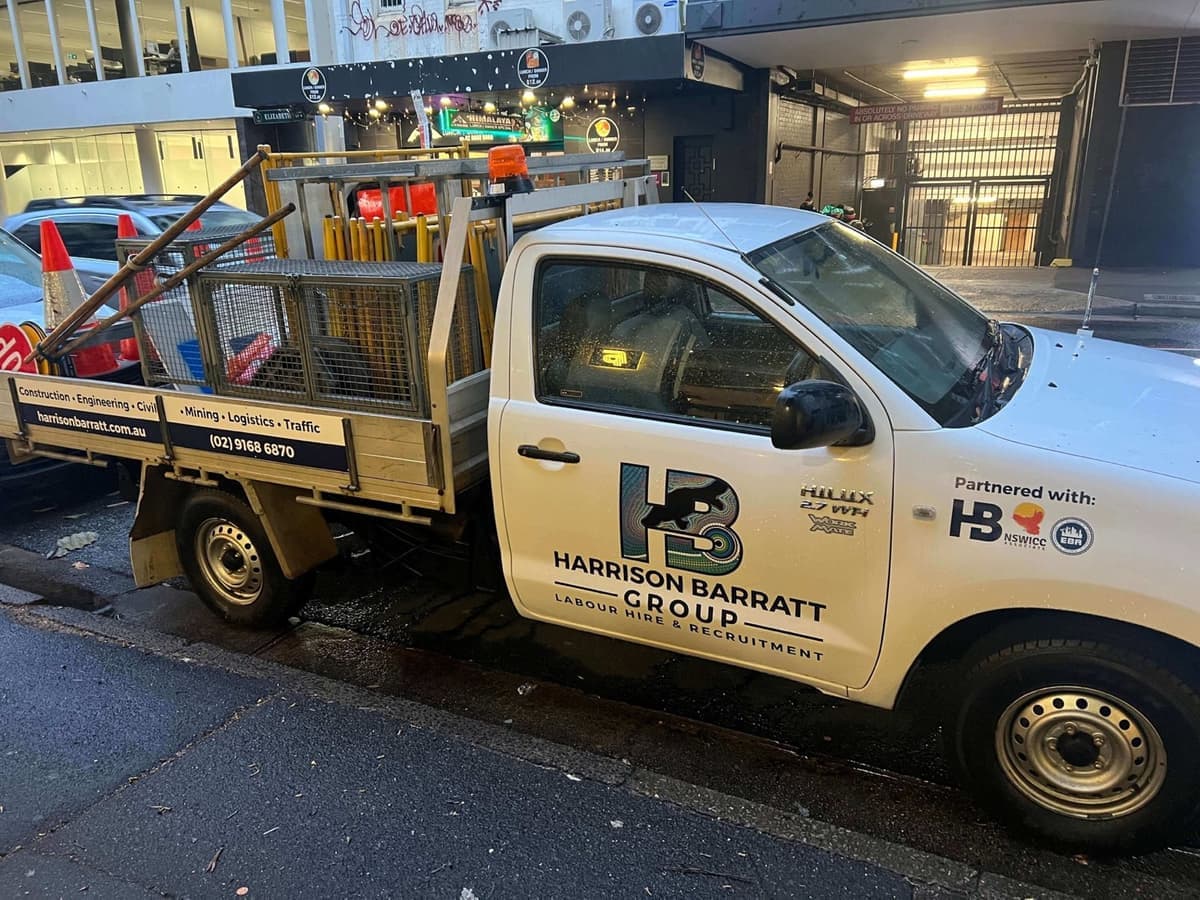
Traffic Management
Certified Traffic Control, Day & Night
HBG supplies certified traffic controllers, TMIs, and traffic management designers to road works, construction sites, and civil projects across Australia. Every worker holds current tickets. Every deployment is compliant. Day shifts, night shifts, weekend shutdowns — we staff them all.
Why HBG
Compliant, Certified & Available Now
Traffic management is a compliance-critical role. We treat it that way — every ticket verified, every worker inducted, every deployment documented.
Fully Certified Workforce
Every traffic controller we deploy holds a current traffic control ticket, Stop/Slow bat certification, and relevant state-based accreditations. We verify all certifications before deployment — no exceptions, no expired tickets.
Night Work & 24/7 Availability
Road works don't stop at 5pm. We supply traffic controllers for night shifts, weekend shutdowns, and 24-hour road closures. Our on-call team processes after-hours orders so you have certified TCs on-site when the cones go out.
Site Induction Ready
All traffic management personnel complete site-specific inductions before they start. White cards, PPE compliance, and any client-specific safety requirements are handled before deployment — not on arrival.
Multi-State Coverage
Traffic control regulations differ by state. We supply workers with the correct state-based certifications across NSW, QLD, VIC, WA, and ACT — ensuring full compliance with local road authority requirements.
Roles We Fill
Every Level of Traffic Management
From the bat holder on the ground to the designer preparing TMP submissions — we staff every tier.
Traffic Controllers (TC)
Certified Stop/Slow operators for construction zones, road works, and event management. Day and night shift availability.
Traffic Management Implementers (TMI)
Experienced TMIs who set up, monitor, and adjust traffic management plans on-site. Capable of managing complex multi-lane configurations.
Traffic Management Designers (TMD)
Qualified TMDs who design traffic management plans compliant with MUTCD and state-based standards for council and RMS/TMR approval.
TMP Writers & Planners
Specialist traffic management plan writers who prepare documentation for road occupancy licences, council permits, and client submissions.
Where We Deploy
Traffic Control for Every Scenario
Road construction and maintenance works
Civil infrastructure projects (bridges, tunnels, utilities)
Building construction sites with road frontage
Emergency road closures and incident response
Event traffic management (concerts, sporting events)
Utility and telecommunications works
Council and government road upgrades
Rail corridor works requiring road traffic control
Industry Insight
Traffic Management in Australia
Traffic management is a critical safety function on every road construction, civil infrastructure, and utility project in Australia. With billions of dollars invested annually in road upgrades, motorway expansions, and urban infrastructure, the demand for certified traffic controllers and traffic management professionals continues to grow across all states and territories. Major projects such as the Western Sydney Aerotropolis road network, Melbourne’s North East Link, Brisbane’s Cross River Rail surface works, and Perth’s METRONET level crossing removals all require large-scale traffic management workforces deployed around the clock.
The traffic management industry in Australia is tightly regulated at both state and national levels. Each state and territory has its own certification framework, and workers must hold the correct state-issued ticket to operate legally. The Australian Standard AS 1742.3 and the Manual of Uniform Traffic Control Devices (MUTCD) set the national baseline for temporary traffic management, but each road authority — including Transport for NSW (TfNSW), the Department of Transport and Main Roads (TMR) in Queensland, VicRoads, Main Roads Western Australia, and the Department for Infrastructure and Transport in South Australia — adds its own requirements and approval processes for traffic management plans, road occupancy licences, and traffic guidance schemes.
HBG operates in this complex regulatory environment every day. With over 128,000 candidates on our database and more than 10,800 inducted workers, we maintain a deep bench of certified traffic controllers, TMIs, and TMDs who are ready to deploy at short notice. Our compliance team verifies every ticket, every white card, and every site-specific induction before a worker is assigned to a project — because in traffic management, a compliance failure is a safety failure.
Compliance
Certification & Licensing by State
Traffic control certification requirements vary significantly across Australian states and territories. In New South Wales, traffic controllers must hold a TfNSW-approved Traffic Controller (TC) ticket, commonly referred to as a blue card, and a Stop/Slow bat operator accreditation. Traffic management implementers (TMIs) in NSW require a yellow card, while traffic management designers (TMDs) require a red card. All tickets must be issued by a TfNSW-approved registered training organisation (RTO) and renewed before expiry.
In Queensland, traffic controllers must hold a Construction Industry White Card (previously known as a blue card) plus a Traffic Controller qualification under TMR requirements. Queensland also requires TMIs to hold specific TMR accreditation for implementing traffic guidance schemes on state-controlled roads. Victoria operates under VicRoads requirements, with traffic controllers needing a Traffic Management ticket issued by an approved RTO and compliance with the VicRoads Code of Practice for Worksite Safety. Western Australia requires traffic controllers to hold a Main Roads WA-approved Traffic Controller ticket, and all workers on Main Roads projects must also complete a Main Roads WA Road Safety Awareness induction.
HBGholds labour hire licences in every state where licensing is required, including Queensland under the Labour Hire Licensing Act 2017, Victoria under the Labour Hire Licensing Act 2018, and South Australia under the Labour Hire Licensing Scheme. Our compliance team maintains a real-time register of every worker’s certification status, expiry dates, and renewal schedules, ensuring that no worker is deployed with an expired or incorrect ticket.
Role Detail
What Each Traffic Management Role Involves
Traffic Controller (TC)
Traffic controllers are the frontline workers who physically direct traffic using Stop/Slow bats, cones, barriers, and signage at road work sites. They must hold a current TC ticket issued by a state-approved RTO, a valid white card (general construction induction), and appropriate PPE including high-visibility clothing. Traffic controllers often work in crews of two or more, with minimum crew sizes dictated by the traffic management plan and road authority requirements. Night work, weekend shutdowns, and extended shifts are common, particularly on high-volume roads where works must occur outside peak hours. Experienced TCs understand lane closures, speed zone setups, and emergency vehicle access protocols.
Traffic Management Implementer (TMI)
TMIs are responsible for setting up and managing traffic control devices on-site in accordance with an approved traffic management plan (TMP). This includes placing and adjusting signs, cones, water-filled barriers, arrow boards, and variable message signs. TMIs must understand the MUTCD, read and interpret traffic guidance schemes, and make real-time adjustments to traffic layouts as conditions change. In NSW, TMIs hold a yellow card accreditation. TMIs also conduct on-site inspections to ensure traffic control setups remain compliant throughout the duration of works, and they liaise with road authorities and principal contractors to resolve any compliance issues.
Traffic Management Designer (TMD)
TMDs design traffic management plans for submission to road authorities and councils. They produce traffic guidance schemes showing lane configurations, speed zone reductions, signage placement, and pedestrian management arrangements. TMDs must have detailed knowledge of AS 1742.3, the MUTCD, and state-specific road authority supplements. In NSW, TMDs hold a red card accreditation. Their plans must be technically accurate, compliant with all relevant standards, and practically implementable by on-site TMI and TC teams. TMDs often work in office environments but conduct site visits to verify that designed solutions are appropriate for the physical road geometry and traffic conditions.
TMP Writer & Planner
TMP writers prepare the complete documentation package required for road occupancy licences (ROLs), council approvals, and client submissions. This includes traffic management plans, risk assessments, community notification plans, and environmental management considerations where required. TMP writers must understand the approval processes for each road authority and local council, including typical turnaround times, common conditions of approval, and variation request procedures. On major infrastructure projects, TMP writers may need to prepare multiple plans covering staged works, temporary diversions, and night-work-specific configurations. They coordinate closely with project managers, civil engineers, and road authority officers to ensure approvals are granted before works commence.
National Coverage
Traffic Controllers Across Australia
HBG deploys traffic management personnel across every major metropolitan and regional area in Australia. In New South Wales, we supply traffic controllers to road works and civil projects across Greater Sydney, the Hunter Valley, the Central Coast, Wollongong, and regional NSW including the New England, Central West, and Riverina regions. In Queensland, our coverage extends from Brisbane and the Gold Coast through to Townsville, Cairns, and remote western Queensland mining corridors where road construction intersects with resource sector activity.
Victoria is serviced with traffic controllers and TMIs for Melbourne metropolitan projects, the Geelong region, Ballarat, Bendigo, and the Gippsland corridor. In Western Australia, we supply certified TCs for Perth metropolitan road works, Bunbury, Geraldton, and Pilbara resource corridor road projects. South Australia and the ACT are covered from our Adelaide and Canberra operations, with traffic management personnel available for both metropolitan and regional deployments. Our national footprint means we can mobilise certified traffic controllers to any location in Australia, with same-day availability in most capital cities and 24 to 48 hours for regional and remote sites.
FAQ
Frequently Asked Questions
Common questions about traffic management staffing and compliance.
What certification does a traffic controller need in each state?
Traffic controller certification requirements differ by state. In NSW, TCs need a blue card (Traffic Controller ticket) issued by a TfNSW-approved RTO. In Queensland, they need a TMR-approved Traffic Controller qualification. Victoria requires a VicRoads-approved Traffic Management ticket. Western Australia requires a Main Roads WA-approved TC ticket. In all states, traffic controllers also need a current Construction Industry White Card (general construction induction). HBG verifies all state-specific certifications before any worker is deployed to ensure full compliance with local road authority requirements.
What is a traffic management plan (TMP) and when is one required?
A traffic management plan is a documented plan that details how traffic, pedestrians, and cyclists will be safely managed around a worksite that affects a road or road-related area. TMPs are required for virtually all works that impact road users, including lane closures, footpath closures, speed zone reductions, and detour routes. The TMP includes traffic guidance schemes showing signage, cone, and barrier placement; risk assessments; worker and public safety measures; and emergency response procedures. TMPs must be approved by the relevant road authority or council before works commence, and they must be implemented on-site by a qualified TMI.
What are the minimum crew sizes for traffic control setups?
Minimum crew sizes for traffic control are determined by the traffic management plan and the complexity of the traffic layout. A basic Stop/Slow operation on a two-lane road typically requires a minimum of two traffic controllers — one at each end of the work zone. More complex setups involving multi-lane closures, intersection management, or pedestrian diversions may require four or more TCs plus a TMI to oversee the traffic layout. Night work operations often require additional personnel for safety. Road authority requirements and principal contractor policies may also mandate specific crew compositions. HBG reviews every deployment request against the TMP to ensure the correct number of certified personnel are supplied.
What are the rates for night work traffic control?
Night work rates for traffic controllers vary by state, day of the week, and specific shift hours. Night shifts typically attract penalty rates under the applicable enterprise agreement or modern award, with rates increasing further for work performed on weekends and public holidays. HBG provides transparent charge rates that include all employment costs, superannuation, workers’ compensation, payroll tax, and applicable penalty loadings. We provide a detailed rate schedule for every engagement so our clients know exactly what they are paying and can budget accordingly. Contact our team for current night work and weekend rates in your state.
Do your traffic controllers hold RMS or TMR accreditation?
Yes. All HBG traffic controllers hold the required road authority accreditation for the state in which they are deployed. In NSW, this means TfNSW (formerly RMS) approved Traffic Controller tickets. In Queensland, our TCs hold TMR-approved qualifications. In Victoria, they hold VicRoads-approved tickets, and in WA, Main Roads WA-approved certifications. Our compliance team maintains a live register of every worker’s ticket details, issue dates, and expiry dates, and we proactively manage renewals to prevent any gaps in certification. We do not deploy workers with expired or incorrect state accreditations under any circumstances.
Can you supply traffic controllers at short notice?
Yes. HBG maintains a large pool of pre-vetted, inducted, and certified traffic controllers who are available for rapid deployment. In most capital cities, we can supply certified TCs within the same business day for urgent requirements. Our on-call team operates outside standard business hours to process after-hours and weekend orders, ensuring that emergency road closures, incident response works, and unplanned utility repairs are staffed promptly. For planned deployments, we recommend providing 48 to 72 hours notice to ensure the best match of experience and availability, but we understand that construction and civil work schedules change rapidly and we are equipped to respond accordingly.
See It in Action
Read how HBG managed traffic control across multiple Sydney sites simultaneously.
Multi-Site Traffic Management Across SydneyNeed Certified TCs on Site?
Whether it’s a two-person Stop/Slow setup or a multi-lane road closure, HBG has the certified traffic controllers ready to deploy. Call now for same-day availability.
All traffic controllers hold current state-based certifications and Stop/Slow accreditation.